
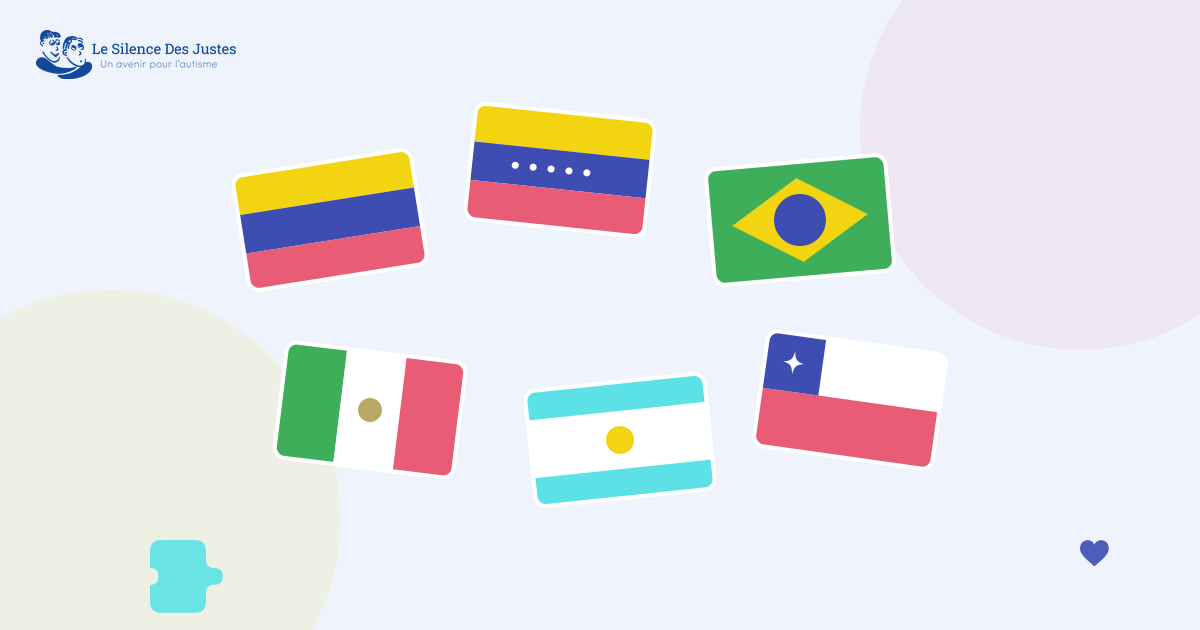
No major national studies, recent laws, a unique ID card in Brazil: the state of knowledge on autism across Latin America.
The Real Number in This Article: The Absence of One
A regional estimate, based on 2011-2013 data, puts autism prevalence in Latin America between 25 and 30 cases per 10,000 people — roughly 0.25% to 0.3%, well below North American or European estimates (often close to 1%). This is almost certainly not because autism is less common there, but because it's far less often identified and diagnosed.
No country in the region has a national surveillance network comparable to the American CDC or the British NHS. Most available figures come from a handful of isolated, often outdated studies covering a single neighborhood or city — never an entire country.
Country by Country: What We Actually Know
A single, dated national study (27.2 per 10,000, believed to be an underestimate). But a real legal framework: the Berenice Piana Law (2012) and the CIPTEA ID card. An April 2026 study found that 39.9% of autistic students receive no school support at all.
The best-documented country in the region: a 2024 study covering 3 million school-aged children (0.46% prevalence), backed by a dedicated autism law passed in 2023 (Law No. 21,545).
No national epidemiological data existed until a 2016 regional study (a single city, León) found 0.87% prevalence among 8-year-olds.
An old study (2008, San Isidro area) remains the only direct reference. Facing this gap, researchers in Buenos Aires recently tried estimating prevalence through disability ID issuance records — a workaround, not a genuine epidemiological study.
No direct epidemiological study has ever been conducted. A recent estimate relies solely on administrative data from the public health system (SISPRO), for the year 2019.
A single, similarly dated study (2008) estimated prevalence at 0.17% — among the lowest and least updated figures in the entire region.
Chile, the Exception That Proves the Rule
Chile stands clearly apart from the rest of the region. Its 2023 law (No. 21,545) explicitly requires accurate epidemiological estimates for the right to inclusion to mean anything in practice — a rare requirement, which led to a genuine national study the following year.
That study also reveals marked disparities by background: children of Mapuche descent show a prevalence of 0.35%, Aymara children 0.65%, compared with 0.47% for the rest of the population — differences that most likely reflect unequal access to diagnosis across regions and communities, rather than a genuine biological difference.
What This Actually Means for a Family
Without a major national study, it becomes difficult for a government to plan how many facilities, trained professionals, or places are actually needed — public policy moves forward blind, without reliable numbers to build on.
Brazil illustrates this tension well: an ambitious law (Berenice Piana) and a genuinely concrete tool (the CIPTEA card) exist on paper, yet the April 2026 study shows that nearly 4 in 10 autistic students get no real support from either today.
What Really Sets This Region Apart From France
The difference isn't really in the laws — Brazil and Chile both have ambitious ones. It's in the knowledge infrastructure behind them. France, despite its own blind spots, has the SNDS and regular epidemiological bulletins (Santé Publique France) that allow needs to be tracked with real precision over time. That statistical infrastructure, often invisible, may be exactly what Latin America is missing most to turn ambitious laws into measurable results.
Frequently Asked Questions
Because no country in the region has a national surveillance network comparable to those in the US or UK — most figures come from isolated, dated studies covering a single city rather than an entire country.
An autism-specific identification card, created under the Berenice Piana Law, that makes it easier for autistic people and their families to access rights and services.
Chile, thanks to a 2024 national study covering 3 million school-aged children, backed by a 2023 law explicitly requiring accurate estimates.
What isn't counted can't really be served — the absence of numbers is never neutral.
This "Around the World" series is a reminder that no country has fully solved the question of autism support at every stage of life — each one moves forward with its own strengths, and its own blind spots.
Sources: Agência Brasil (April 2026); ScienceDirect, Colombia estimate (SISPRO, 2019); Fombonne et al., León, Mexico study (2016); medRxiv, Chile prevalence (2024); medRxiv, Buenos Aires study; Grokipedia, CIPTEA card; Zeidan et al. (2022), regional estimates by continent.
— ◆ —
Every donation matters
Your support helps the association continue its work with autistic people and their families.
Support UsYou May Also Like

Daniel Tammet: Autism, Synesthesia, and a World Record
For most of us, the number 4 is just a number. For Daniel Tammet, it's a shy, quiet shape — his favorite, he says, because it reminds him of himself. Autistic, synesthetic, and a polyglot, this Englishman broke a European record reciting 22,514 decimal places of π from memory. Here's the story of a mind that perceives the world differently.

Autism Volunteering: Join Our 30th Anniversary Campaign
Le Silence des Justes is celebrating its 30th anniversary on October 21, 2026. To make this milestone count, we're recruiting volunteers — flyering, online outreach, phone calls. Here's how to join us.
Anthony Hopkins and Autism: Portrait of an Atypical Genius
Anthony Hopkins, diagnosed with Asperger's syndrome, grew up as a child deemed "totally inept.". A look back at the extraordinary journey of an actor who turned his difference into a strength.