Autisme en France : Bilan 2026 de la stratégie nationale
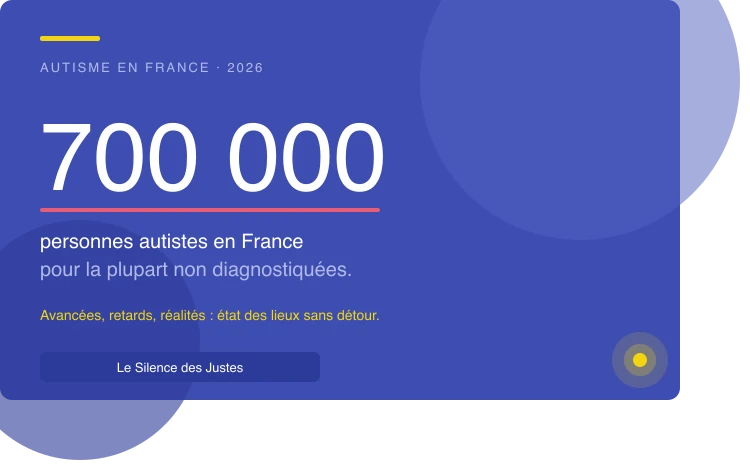
700 000 personnes concernées en France, un rapport parlementaire qui dénonce un "immense retard historique" publié en mai 2026, une recherche qui accélère — et des listes d'attente qui ne bougent pas. L'autisme en France en 2026, c'est l'histoire d'un pays en transition : il comprend mieux, mais peine encore à agir à la hauteur de ce qu'il sait.
Entre les avancées réelles — nouveaux centres d'excellence, stratégie nationale TND 2023–2027, intelligence artificielle au service du diagnostic précoce — et les réalités qui demeurent — trois ans d'attente pour un bilan, autisme adulte sinistré, inégalités territoriales criantes — la France avance. Trop lentement au goût des familles qui vivent ces défis au quotidien.
C'est précisément dans ce contexte que des associations comme Le Silence des Justes jouent un rôle irremplaçable : accompagner les familles, briser l'isolement et porter une parole là où le système institutionnel n'arrive pas encore. Parce qu'entre ce que la France promet et ce que les familles vivent, il y a encore un fossé — et c'est ce fossé que nous cherchons, chaque jour, à combler.
Ces chiffres posent d'emblée le problème central : entre la réalité du nombre de personnes autistes et la capacité du système à les repérer, diagnostiquer et accompagner, le fossé reste immense. Et ce fossé a des conséquences directes sur des centaines de milliers de vies.
Ce qui avance : les vraies bonnes nouvelles
- 🏛️ Une stratégie nationale structurée jusqu'en 2027 : Lancée en 2023, la stratégie TND couvre l'autisme, les Dys, le TDAH et le TDI. Son bilan 2025–2026 témoigne d'avancées en recherche, diagnostic, scolarisation, insertion et formation.
- 🔬 Six centres d'excellence en recherche : Un sixième centre a ouvert à Bordeaux en 2025, appuyés par 27 CRA pour les diagnostics complexes.
- 🤖 L'IA au service du diagnostic précoce : En 2026, l'IA permet de détecter certains marqueurs avec 80 à 90 % de précision en conditions expérimentales.
- 🏫 664 dispositifs scolaires spécialisés : Plus de 5 600 élèves accueillis dans un cadre adapté en 2025–2026.
- 🎓 Le programme Atypie-Friendly : En 2026, de nombreux étudiants bénéficient d'un accompagnement spécifique pour l'enseignement supérieur.
- 📋 Nouvelles recommandations HAS : L'approche privilégie désormais un "parcours de vie" global centré sur l'autonomie.
✓ À retenir : La France dispose aujourd'hui d'un cadre institutionnel et scientifique sérieux qui n'existait pas il y a dix ans. C'est un progrès réel — qu'il faut reconnaître sans l'amplifier.
Ce qui pose problème : les réalités qui demeurent
- ⏳ 3 ans d'attente minimum en CRA : Le délai reste inchangé. Les familles se tournent vers le privé, avec des bilans coûteux et non remboursés.
- 📊 Absence de statistiques fiables : Le rapport 2026 déplore l'absence de données réelles sur le nombre de personnes autistes.
- 👩 Les femmes autistes : Trop peu de médecins sont formés au profil féminin, menant à des diagnostics tardifs ou erronés.
- 🧑 L'autisme adulte : Moins de 10 % d'insertion professionnelle pour les personnes avec TDI ; la transition 18 ans est critique.
- 📍 Inégalités territoriales : L'accès aux soins varie radicalement selon les régions, forçant parfois l'exil vers la Belgique.
- 🏥 Hospitalisation en psychiatrie : Des adultes sans diagnostic sont encore hospitalisés en psychiatrie dans des conditions inadaptées dénoncées par l'IRDES.
"Comment construire des politiques publiques en étant myope ? Il n'existe en France aucune statistique fiable sur le nombre de personnes souffrant d'un trouble du spectre autistique."
Ce que la recherche promet
La recherche internationale, soutenue par des travaux comme ceux de Thomas Bourgeron, se concentre désormais sur une réalité multifactorielle. L'objectif n'est plus de "guérir" mais d'accompagner chaque profil unique.
🔬 Repère scientifique : L'IA permet de détecter des marqueurs autistiques avec 80 à 90 % de précision en conditions expérimentales. Elle pourrait permettre un repérage bien plus précoce qu'actuellement.
Chaque don compte
Votre soutien permet à l'association de poursuivre son accompagnement auprès des personnes autistes et de leurs familles.
Nous SoutenirVous aimerez aussi

Moments précieux et apprentissage
Dans cet article, Le Silence des Justes souligne combien les moments du quotidien peuvent devenir de véritables opportunités d’apprentissage. À travers des expériences partagées, les familles découvrent que détente, interaction et accompagnement bienveillant favorisent le développement des compétences. Ces instants précieux, simples en apparence, jouent un rôle essentiel dans l’épanouissement et la progression des enfants avec autisme.

Comment naviguer dans le système scolaire avec un enfant autiste
Naviguer dans le système scolaire avec un enfant autiste implique de connaître les ressources disponibles, de communiquer efficacement avec les enseignants et d’adapter l’environnement d’apprentissage aux besoins spécifiques de l’enfant. L’article propose des conseils pratiques pour faciliter la scolarisation, renforcer la collaboration entre la famille et l’école, et offrir un soutien adapté qui favorise la réussite et le bien‑être de l’élève autiste.

30 ans au service de l'autisme
Depuis 1996, Le Silence des Justes accompagne les enfants, adolescents et adultes autistes vers une vie épanouie en milieu ordinaire. Le 21 octobre 2026, l'association célèbre trois décennies d\'un combat humain, médical et social hors du commun.